How Brands Can Respond to Real-Time Customer Intent
Traditional ecommerce personalisation often starts with predefined segments. A customer lands on a website and sees a product recommendation, banner or offer based on what the brand already assumes about them.
Adaptive commerce works differently.
At eTail Asia, we spoke with Vanessa Miranda, Regional E-commerce Lead, SEA & India at Nestlé Nespresso, about how brands can read real-time customer signals, identify intent and turn data into more relevant commercial action. Vanessa describes adaptive commerce as a shift from fixed segments towards behavioural, contextual and lifecycle signals that help brands respond to what customers are doing in the moment.
3 Takeaways from the Interview
Key takeaway | Why it matters |
Move from segments to signals | Adaptive commerce responds to what customers are doing in the moment, not just which segment they belong to. |
Focus on the middle-intent shopper | Customers who browse, compare, add and remove from cart can be a valuable opportunity to influence. |
Operationalise the data | Data only creates value when ecommerce, sales and marketing teams can act on it at the right time |
The shift: from predefined segments to adaptive intent
Vanessa explains that adaptive commerce is built around customer signals.
These signals can include how long someone spends on a page, what keywords they search, what they add to cart, what device they use, when they visit, and whether they are a new or returning customer.
The goal is not just to personalise the website. It is to understand what the customer is showing you in that moment, then respond with a more relevant experience.
Why the middle-intent customer matters
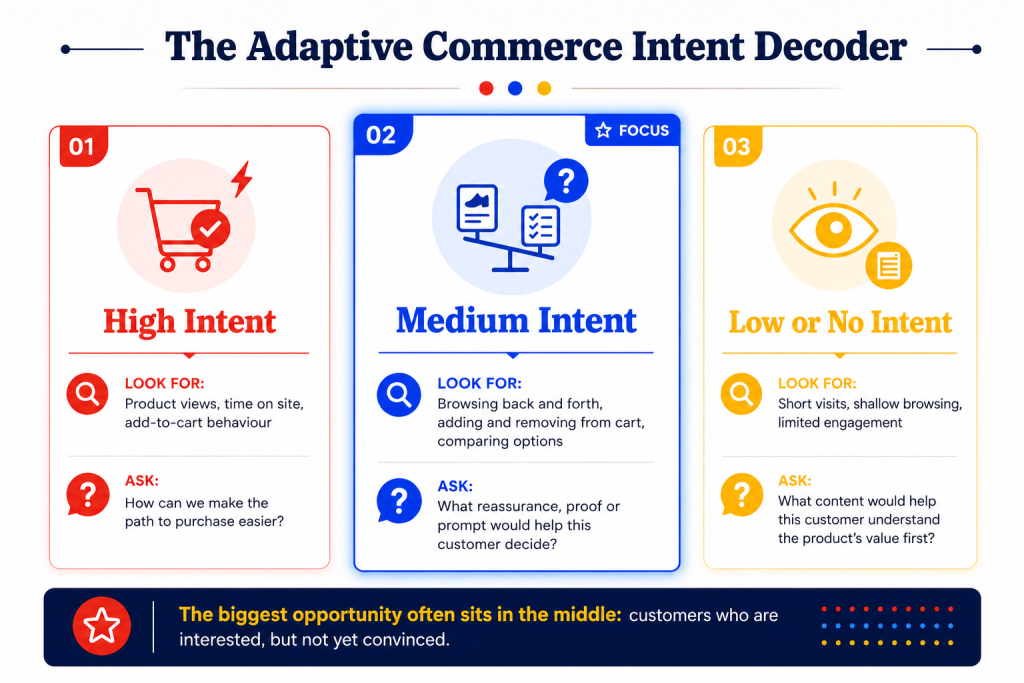
One of Vanessa's most practical points is that the most valuable opportunity is not always the customer who is already ready to buy.
It is often the customer sitting in the middle.
These shoppers are browsing back and forth, adding and removing items from cart, comparing options and showing signs of hesitation.
For ecommerce teams, this group can be a goldmine. With the right message, reassurance or offer at the right time, brands have a stronger chance of moving them towards purchase.
Jump to 2:40 to hear Vanessa explain why middle-intent shoppers can be one of the biggest opportunities in adaptive commerce.
Why data needs an owner
Vanessa also highlights one of the biggest challenges in adaptive commerce: fragmented data. Many businesses have plenty of data, but it often sits across different systems. The challenge is not only bringing that data together, but turning it into something teams can actually use.
For Vanessa, technology should support better decisions and business goals. Data teams can help surface insights, but commercial teams need to know how to act on them.
How to stay relevant without becoming intrusive
Adaptive commerce only works when the experience matches the customer's intent.
Vanessa notes that personalisation can start to feel intrusive when the landing page or experience does not meet what the customer is actually looking for.
There is also a fine line around data privacy.
The opportunity is to be helpful, not heavy-handed: showing the right product, message or content when it genuinely supports the customer's journey.
Watch the full interview with Vanessa Miranda for more on customer signals, data ownership and how brands can make adaptive commerce feel helpful rather than intrusive.
Want more retail and ecommerce insights from eTail Asia?
Explore more conversations with retail leaders as we unpack the ideas shaping customer experience, digital commerce, brand growth and omnichannel strategy across Asia.